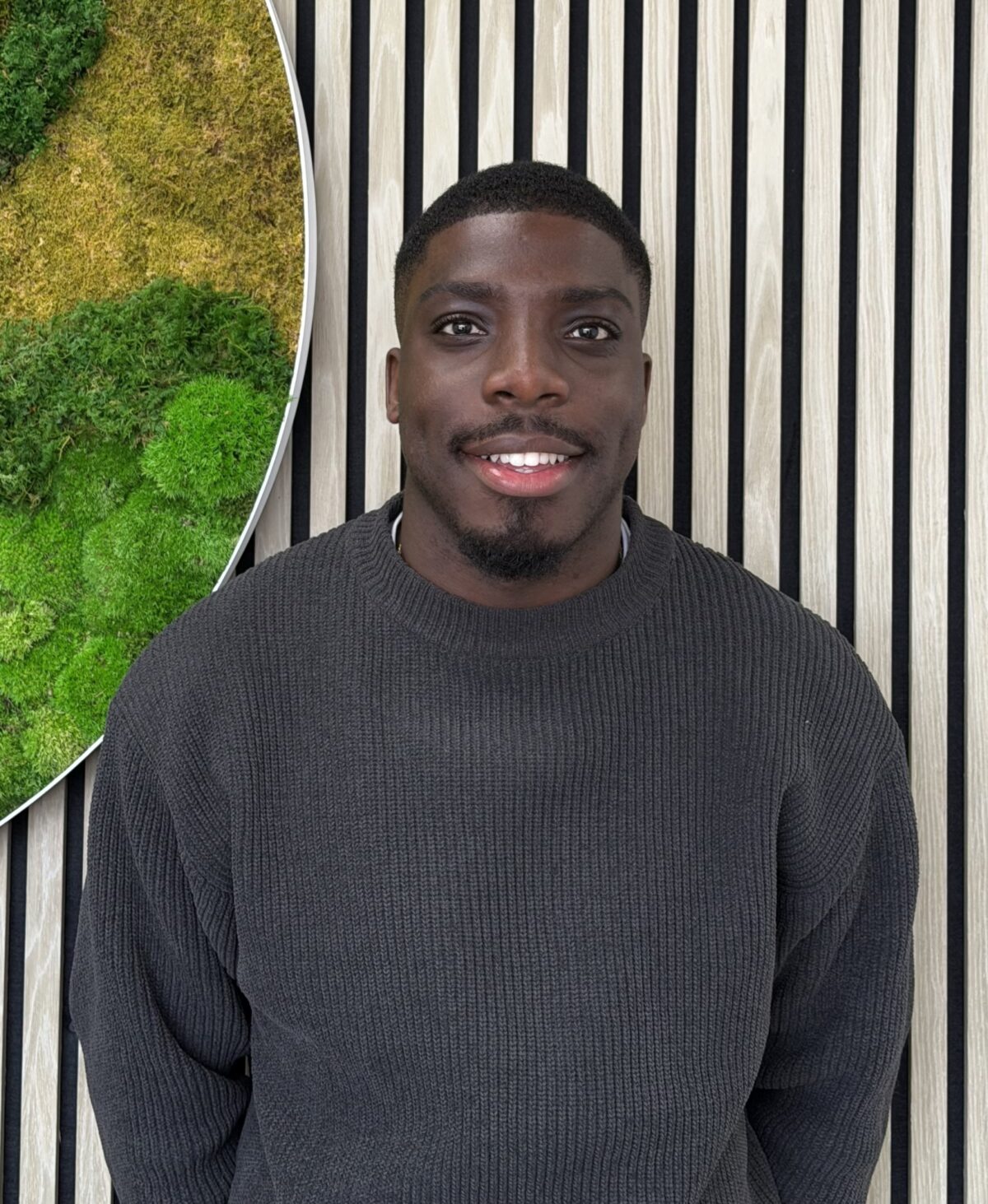
Junior Akete-Tshekoya
2026 Saltire Scholar
AI & Automation Intern, Simple Online Healthcare
Biomedical Science, University of Strathclyde
When I started my internship at Simple Online Healthcare, I knew I was stepping into something very different from what I was used to.
As a Biomedical Science student at the University of Strathclyde, most of my university experience has naturally centred around science, laboratories and healthcare. AI, automation and customer experience weren't areas I had previously imagined myself working in.
That was exactly what made the opportunity so exciting.
Through the Saltire Scholars Programme, I joined Simple Online Healthcare as an AI & Automation Intern within the Patient Experience team. I went into the summer hoping to develop my professional skills and experience working in a business environment. What I didn't expect was just how much responsibility I would be given or how much the experience would change my understanding of technology within healthcare.
A major focus of my internship was looking at how AI and automation could improve the experience patients have when contacting an online healthcare provider.
On the surface, receiving a question from a patient and providing an appropriate response might seem straightforward. Once I started working with the systems behind those interactions, I quickly realised how much happens in the background.
Much of my work involved Zendesk, AI agents, knowledge content and automated customer service processes.
The main AI agent I worked with throughout my internship was Simple Online Healthcare's customer-facing digital agent. A large part of my role involved testing the agent, reviewing how it responded to different patient enquiries and identifying areas where the patient journey could be improved.
Working so closely with the agent taught me that improving an AI system isn't simply about whether it can produce an answer. I had to think about whether it had actually understood what the patient was asking, whether it was using the right information and whether the conversation felt natural from the patient's perspective.
Another part of my role involved investigating Zendesk triggers and automations.
This meant looking behind the patient-facing conversation and understanding what happened to a ticket after someone contacted the company: how it was categorised, where it was sent, whether it was assigned to the correct team and what happened if the patient contacted us again.
One thing I quickly learned was that changing one part of an automated system can sometimes have an unexpected effect somewhere else.
That made testing an important part of my work. I would create or change a process, test it using different patient scenarios, identify where it behaved unexpectedly and then go back to understand why.
Instead of seeing that as failure, I learned to treat it as part of the process:
Test. Identify the problem. Understand why it happened. Improve it. Test again.
That became a big part of how I approached my internship.
Working across different areas helped me understand that AI agents don't operate in isolation. The knowledge behind them, the procedures they follow and the automated systems supporting them all contribute to the overall patient experience.
One of the projects I am most proud of was having the opportunity to create and develop a new AI agent for Simple Online Healthcare's Australian branch.
After spending much of my internship working with an established customer-facing AI agent, this project gave me the opportunity to take what I had learned and apply it to developing a new one.
It wasn't simply about giving the AI information and expecting it to answer questions correctly. I had to think about how a real patient would interact with it and how the agent should behave across different patient journeys.
Seeing the agent gradually improve was incredibly rewarding.
It also gave me a greater sense of ownership. For someone who entered the internship with limited experience of AI and automation, being trusted with a project like this was something I was particularly proud of.
Working with AI in a healthcare environment also taught me that a system being capable of answering something doesn't necessarily mean that it should.
There needs to be a clear boundary between what can be automated and what requires human judgement. Part of my work involved helping ensure that those boundaries were clear, particularly where an enquiry needed input from the Patient Care Team or an appropriate clinical professional.
That was an area where my Biomedical Science background became unexpectedly relevant. My degree has trained me to think about evidence, accuracy and the consequences of getting something wrong. During my internship, I found myself applying that same mindset to AI and automation.
One of the most rewarding things about the internship was knowing that the problems I was working on were real.
I wasn't completing a university exercise where the answer was already known. The systems I was working with supported real patient journeys.
That meant even relatively small improvements could have a wider impact.
It gave me the feeling that I wasn't simply there to learn from the company; I was also able to contribute to it.
I expected the biggest challenge to be learning the technical side of AI and automation.
One of the biggest things I actually learned was how important communication is.
Throughout the internship, I had opportunities to work with and learn from people across different areas of the business. I became much more comfortable asking questions, explaining what I had found and suggesting changes.
At the beginning of the internship, it was easy to think of myself as the intern surrounded by people who had far more experience than me.
As the weeks went on, that changed. I became more confident sharing my opinion, suggesting improvements and taking ownership of the problems I was working on. That change in confidence is probably one of the things I am most proud of from the summer.
Before becoming a Saltire Scholar, if someone had asked me where a Biomedical Science degree could take me, AI and automation probably wouldn't have been near the top of my list.
Now I look at that question very differently.
My internship showed me how interconnected healthcare and technology are becoming.
I could see how skills I had developed through Biomedical Science – analysing information, looking for patterns, questioning results, considering evidence and approaching problems systematically – could be applied to something completely different.
Your degree can give you a direction, but it doesn't have to define the limits of where you can go.
My experience at Simple Online Healthcare has given me much more than knowledge of Zendesk and AI systems.
I've become more confident working independently and much more comfortable dealing with problems where there isn't always an obvious answer.
I've also discovered that I enjoy looking at a process, questioning why it works the way it does and finding ways of making it better.
Most importantly, the internship has made me more open-minded about my future and the different directions my skills could take me.
As a Biomedical Science student, I hadn't previously considered how closely my scientific background could connect with areas such as AI, automation and digital healthcare. This experience has shown me that the analytical and problem-solving skills I've developed through my degree can be valuable in many different environments.
If I could give one piece of advice to someone considering applying to the Saltire Scholars Programme, it would be:
Don't only apply for opportunities that look exactly like what you're already studying.
Some of the best experiences can come from putting yourself somewhere unfamiliar.
Ask questions. Speak to people across the organisation. Volunteer to get involved. If you notice something that could be improved, don't be afraid to suggest it simply because you're an intern. You might be surprised by how seriously people take your ideas.
For me, being a Saltire Scholar has been about stepping outside my comfort zone and discovering what I'm capable of when I'm given the opportunity to do something completely different.
I started the summer as a Biomedical Science student who knew very little about the world of AI and automation.
Since then, I've gained practical experience across AI, automation and digital healthcare, built new professional relationships and, most importantly, developed much more confidence in my ability to walk into an unfamiliar environment, learn quickly and contribute.
That's something I'll take with me long after the internship itself is over.